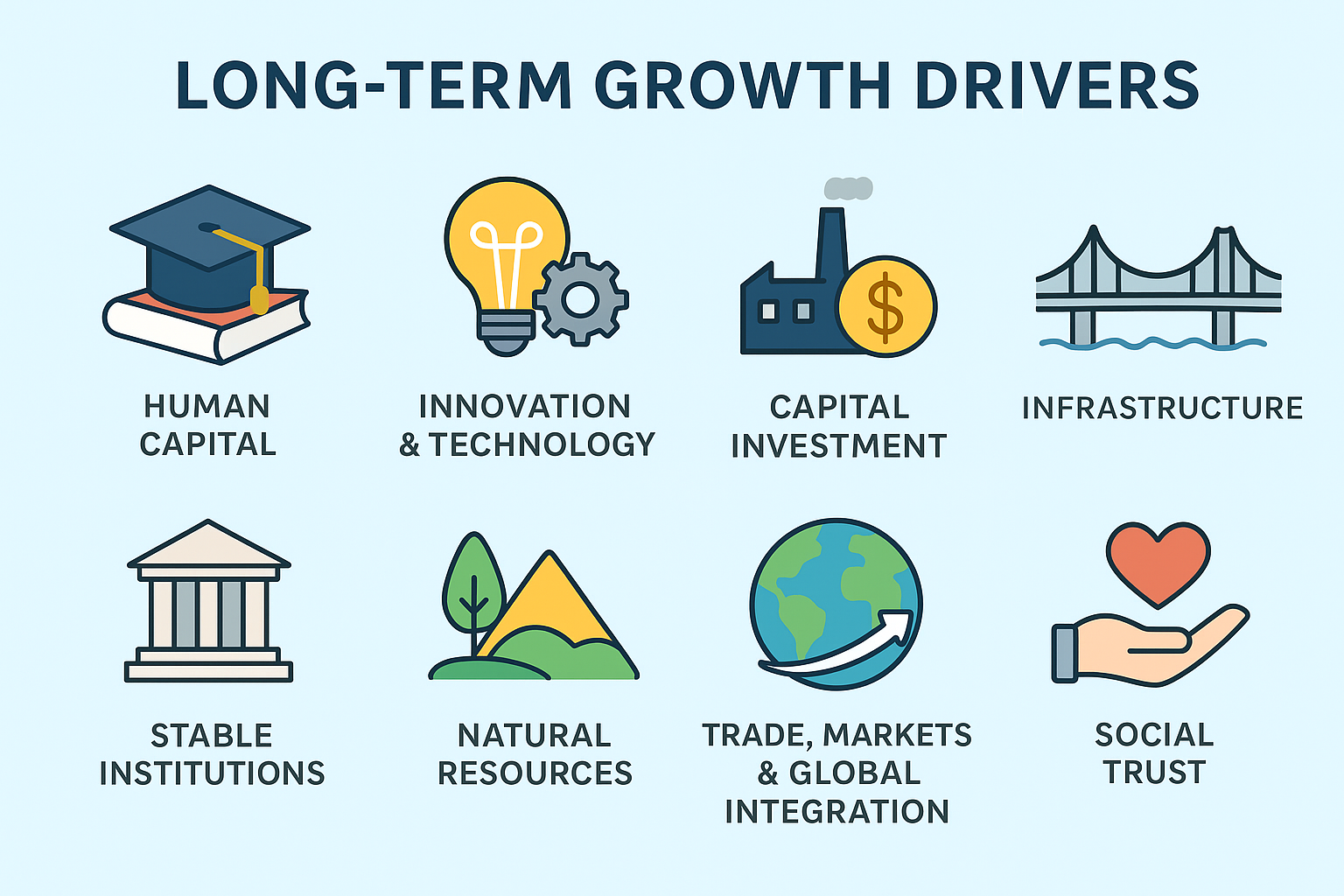
Long-term growth in an economy is not something that happens by accident. It does not occur overnight, nor can it be willed into existence by some desire to finally have progress. It is built up over time-the gradual result of decisions, investments, habits, behaviors, and structural choices that add up. What often distinguishes a prospering nation from a struggling one, or a successful business from a stagnant one, or a financially secure household from a paycheck-to-paycheck one, is a set of drivers of growth that operate beneath the surface, shaping the future at a time when most people only see the present.
Long-term growth drivers represent the deep forces that push an economy forward, such as productivity, innovation, human capital, investment, institutions, infrastructure, natural resources, and social trust. When these forces are strong and aligned, growth feels natural, stable, upward, and continuous. But when they become weak or disrupted, growth becomes unstable, uneven, or stops altogether.
This is the story of progress: not just in GDP charts or corporate earnings, but in the lives and opportunities of people, families, communities, and generations.
Human Capital: The Power of People.
In the center of every growing economy is not machinery, technology, or capital—it’s people. Human capital can be defined as education, skills, and health, which create the capacity to work, innovate, and solve problems. Economies grow when their populations are:
Educated
Healthy
Trained
Motivated
Empowered
A society that invests in its people invests in its future.
Weak education, inadequate learning opportunities, and a paucity of relevant skills among most workers are the factors that slow down the economy-not because the resources are not there, but because the human engine leading to growth is underdeveloped.
Human capital is built by:
Quality schools and universities
Vocational and skill-based training
Access to health
Opportunities for lifelong learning
Cultural and family support for self-development
Countries such as South Korea, Singapore, and Finland are proof that you can be resource-poor and still prosper if your people are empowered.
If people are the engine, then growth is the journey.
Innovation and Technology: Turning Ideas Into Impact.
Innovation is more than just inventing new gadgets or software; it is a process of doing things better, faster, and more efficiently. Technology magnifies human capability; it enables an economy to produce more value out of the same amount of labor or resources.
Innovation fuels long-term growth in various ways:
It increases productivity.
It reduces costs
It creates new industries and new jobs.
It replaces outdated and inefficient methods.
It improves the quality of life and business performance.
The Industrial Revolution, electricity, telecommunications, computing, automation, and artificial intelligence-all are waves of technological change that reshaped economies and societies.
But it’s far from automatic; innovation requires:
Research and development investments
Strong universities and labs
Entrepreneurship culture
Risk-taking tolerance
Intellectual property protection
And most importantly, it requires a mindset-an economy must believe that tomorrow can be better than today.
Economies that are afraid of change stagnate; economies that experiment move forward.
Capital Investment: Laying the Foundations for Production.
For growth to happen, there needs to be investment-capital flowing into factories, technology, real estate, tools, infrastructure, education, and businesses. Investment is the fuel needed for ideas and labor to become real output.
Physical capital includes:
Machinery
Buildings
Roads
Equipment
Digital Infrastructure
Energy systems
When companies invest, workers become more productive. When governments invest in infrastructure, the whole economy becomes more efficient. When people invest in education, their earning power rises.
On the contrary, when investment is low:
Productivity stalls
Wages stagnate
Industries weaken
Growth slows down
The strong long-term growth economies save and invest, as opposed to consuming everything now.
Investment reflects belief in the future. Low investment means people and institutions do not trust tomorrow.
Infrastructure: The Skeleton of the Economy.
Infrastructure refers to the physical base that underpins economic life. Without good infrastructure, even the most talented workers and enterprising businesses struggle to achieve their potential.
Key infrastructure includes:
Transportation: roads, ports, railways, and airports
Energy grids-electricity access and clean energy systems
Water and sanitation systems
Digital infrastructure: internet, data networks
Logistics and supply chains
Good infrastructure:
Reduces waste and inefficiency
Connects producers with consumers
Strengthens trade and commerce
Improves quality of life
Weak infrastructure creates:
Delays
High costs
Inefficiencies
Lost opportunities
Infrastructure is not glamorous, but it’s transformative. No growth happens in its absence.
Stable and Effective Institutions.
Institutions matter: they are the rules of the game—the systems that govern business, law, politics, and social interaction. Growth depends heavily on whether these rules are fair, predictable, and trusted.
Strong institutions include:
Courts that enforce contracts
Financial systems that safely manage capital
Governments that plan responsibly
Public agencies that operate transparently
Legal systems that reduce corruption
Weak institutions create:
Uncertainty
Corruption
Inequality
Distrust
Capital flight
Investors, companies, and workers demand stability. They need to feel that resources will not be stolen, the rules will not change overnight, and success is something earned through hard work, not bought through corruption.
This is where institutional strength often makes the difference between rich and poor nations, sometimes when both have the same natural resource.
Natural Resources and Sustainability
Natural resources—land, minerals, oil, forests, rivers, agricultural capacity—can be blessings or curses depending on how they are used.
Countries that only rely on the extraction of resources without:
Investing in people,
Building institutions,
Encouraging innovation,
often fall into what economists call the resource trap, in that they become dependent, volatile, and easily vulnerable to price changes.
However, the countries that utilize natural resource wealth to:
Fund education
Infrastructure development
Support technology
Strengthen governance
lay the foundation for sustainable long-term growth.
Growth in the future must be green. Climate resilience, renewable energy, water management, and biodiversity preservation are no longer a choice but central to economic security in the future.
Trade, Markets, and Global Integration.
Economies don’t grow in isolation. Growth accelerates when nations connect to larger markets, share knowledge, participate in global trade, attract foreign investment, and learn from others.
Open economies:
Grow faster
Innovate more
Gain efficiency through competition
Specialize in what they do best
However, trade must be fair and strategically managed. Too much dependence on imports or a single export market can lead to vulnerability. Resilience means:
Expanding trading partners
Industry diversification
Developing Domestic Capacity along with Global Engagement
A deeply interdependent world, where long-term growth prospers when nations work with, not against, global systems.
Social Trust and Cultural Mindset.
Growth is not merely structural; it is cultural.
Societies that value:
Learning
Hard work
Cooperation
Innovation
Long-term thinking
tend to make sustained progress.
Societies that fall into:
Short-term thinking
Corruption
Division
Inequality
Cynicism or hopelessness
struggle to grow, no matter how many resources they possess.
Trust is one of the most powerful forms of economic capital. When people trust one another, business cooperation increases. When citizens trust institutions, stability strengthens. When families and communities support education and ambition, potential expands.
Long-term growth is ultimately a story of belief-a belief that progress is possible.
Bringing It All Together
Long-term growth does not depend on any one force, but it is the end result of many interacting components:
Growth Driver What it Provides Why It Matters
Human Capital Skilled and Capable Workers Productive and innovative
Innovation & Technology/New solutions and efficiency/ Moves economy forward faster
Capital Investment Tools, factories, infrastructure Production and expansion
Infrastructure: This provides connectivity and functionality, hence reducing costs and firming up trade.
Institutions\tFairness and stability\tEncourages trust and long-term planning
Natural Resources & Sustainability Base for production Must be used wisely to avoid collapse
Global Trade & Integration\tKnowledge, competition, markets\tMore opportunities
Culture & Social Trust Cooperation and motivation Sustains long-term progress
When these forces come together, growth is not just possible; it becomes inevitable, durable, and widely shared.
Conclusion: The Future Is Built, Not Inherited
Long-term growth is not luck; it’s not happenstance. It’s created on purpose, through:
Wise decisions
Strategic investment
People’s support
Respect for institutions Commitment to progress Economies, businesses, and households that grow steadily over time are those that prepare, adapt, invest, learn, and persist. Growth is not only an economic notion; it is a story of human aspiration. A story of striving. A story of something being built that lasts longer than today.
Leave a Reply