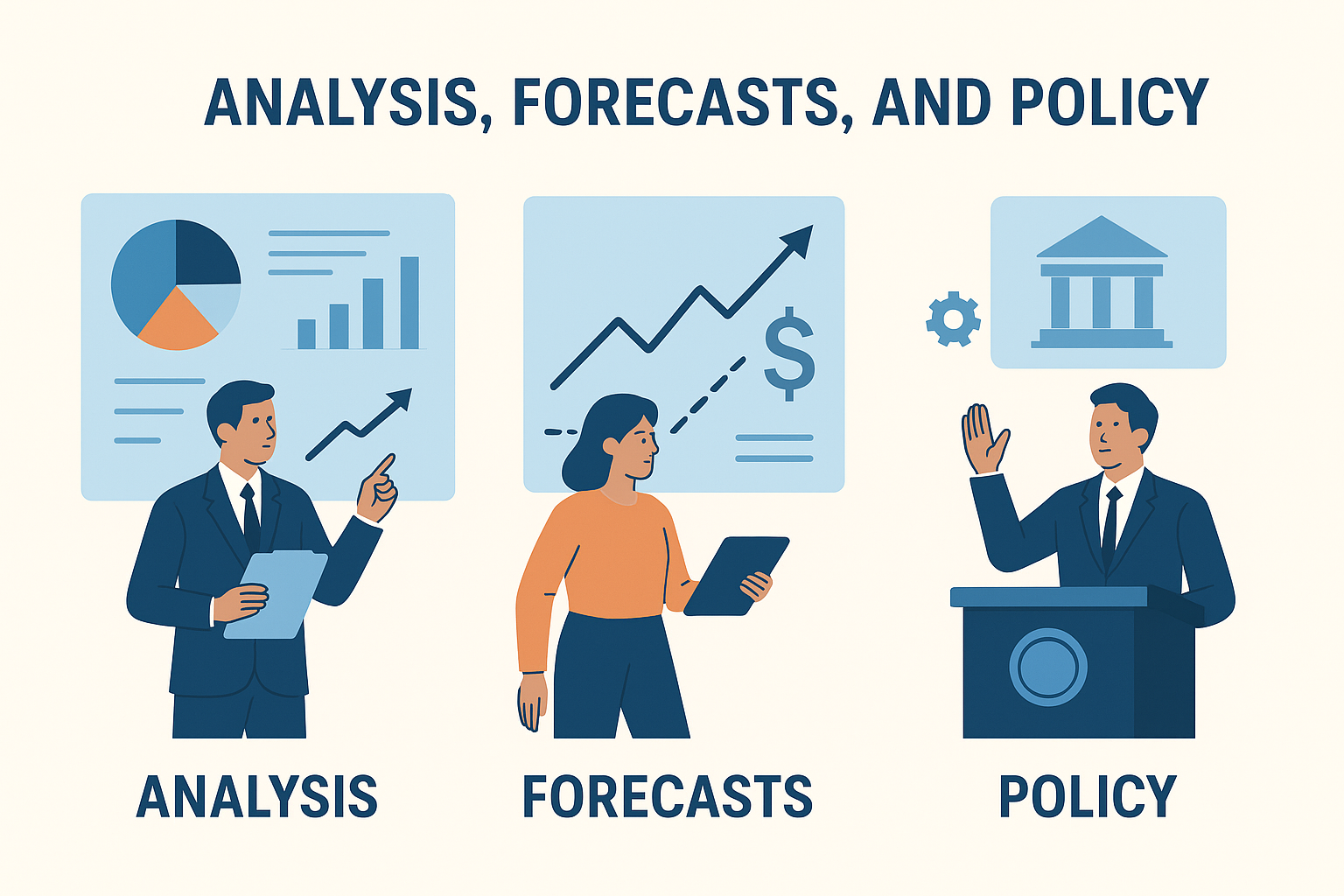
Why These Three Pillars Matter.
Every economy, local or national, global, is an ever-changing living system. It grows and often slows, changes and adapts because every day millions of decisions are made: governments spend or save, businesses invest or cut costs, workers change jobs or stay in the same ones, and consumers buy more or less depending on price and confidence. To understand where an economy stands now, where it is headed, and how to shape its future, economists rely on three foundational activities: Analysis, Forecasts, and Policy.
These are all deeply interconnected. Analysis helps us understand today’s economic conditions. Forecasts attempt to predict tomorrow’s conditions. Policy is the action that governments and central banks take to bring about outcomes. When used well, they enable societies to stabilize markets, support households, promote growth, control inflation, reduce inequality, and prepare for long-term change. When done poorly, or when they are ignored, economies can slide into instability, recession, or crisis.
This chapter provides a detailed, intuitive explanation in human language of these three economic pillars: how they work, how they interact, and why understanding them benefits not only policymakers and investors but everyday workers, students, entrepreneurs, and citizens who want to make informed decisions in their personal and financial lives.
Section 1: Economic Analysis — Understanding the Present :
Economic analysis is the very foundation upon which all economic thinking begins. This means collecting data, interpreting trends, and trying to understand how different parts of the economy are working together-or not. But analysis isn’t just about numbers and charts; it’s ultimately about people: what they buy, how they work, how much they earn, the way businesses operate, and how decisions reverberate throughout society.
1. The Role of Data.
Analysis starts with observing data like:
Inflation rates – how fast prices rise.
Employment and unemployment levels
Wage growth and labor market strength
Consumer spending and saving habits
Investment and production levels of firms
Trade balances and currency movements
Interest rates and credit activity
But data alone is not sufficient. Two economies may have similar inflation rates for completely different reasons. For instance:
Prices may increase as demand is high and people are spending more.
Or it could be higher prices because of supply disruption caused by drought, shortage, war, or shipping problems.
Thus, analysis asks why, not just what.
1.2 Behavioral and Social Factors
Economies are driven by human psychology.
Optimism tends to increase spending and investment.
Fear or uncertainty is a reason to save rather than spend.
This means that confidence indicators are just as important as financial data. For example, during periods of uncertainty, even though people may have money, they will avoid making major purchases, like houses or cars.
1.3 Sectoral and Regional Analysis
Not every part of any economy is moving at the same pace. Some industries expand while others contract. Some regions prosper while others lag behind. Analysis can determine exactly where the opportunities and risks are. The following are some examples:
A growing technology sector may indicate increasing availability of high-skill jobs.
A weakening agriculture sector may indicate food price pressures.
Good analysis also considers global interconnections. An increase in oil prices in one country may raise the cost of transportation throughout the world. A decline in manufacturing activity in China can diminish sales in retailers in Pakistan, exporters in Indonesia, or investors in Europe. In fact, the world economy is strongly intertwined.
1.4 Why Analysis Matters
Without accurate analysis,
Governments sometimes react late to crises.
Businesses may invest in the wrong sectors.
Households may misjudge job stability or financial risks.
In other words, analysis helps us understand reality, and reality must be understood before being improved.
Section 2: Forecasts — Anticipating the Future :
While analysis may look at the present and past, forecasts look toward the future. Forecasting does not mean the prediction of a future with perfect accuracy; it is the construction of probable outcomes based on patterns, models, behaviors, and changing conditions.
2.1 Why Forecasting Is Necessary
Today, people and institutions make decisions based on their expectations of tomorrow.
A business will only invest in a new factory if it expects future demand.
A worker may train for skills that are expected to be in demand years ahead.
A government develops budgets with long-term needs in mind.
Investors decide where to invest their money according to expected returns and risks.
Thus, forecasting supports decisions that shape the future.
2.2 Forecasting Tools
Forecasters use:
Historical data analysis
Mathematical models
Industry trend studies
Demographic projections
Technological trends
Global political and market signals
Yet, forecasting is also a societal activity that requires social acumen.
For example:
If younger generations are spending more on experiences than products, retail businesses need to adapt.
If automation becomes cheaper, jobs that require routine labor might decrease.
2.3 Scenario Planning
Forecasters seldom make a single forecast. What they do is produce scenarios:
Optimal outcome
Most-likely scenario
Worst case scenario
For instance, a country may forecast:
High growth if commodity prices remain strong.
Moderate growth provided that prices stabilize.
Low growth if global demand falls.
2.4 Limits and Uncertainties
Forecasting is not an accurate way, as there can be unnatural events:
Natural disasters
Wars
Pandemics
Sudden political changes
Technological breakthroughs
The best forecasts are flexible, updating themselves as conditions change. Perfection isn’t the goal; readiness is.
Section 3: Policy — Shaping Economic Outcomes :
Analysis diagnoses conditions and forecasts suggest possible futures; policy is the conscious action taken to influence those futures.
3.1 Fiscal Policy
Fiscal policy is government decisions on spending and taxation.
When economic growth slows, a government may try to stimulate the economy with increased spending.
In instances of inflation, governments cut spending or increase taxes to reduce demand.
Spending may go toward:
Infrastructure: roads, energy systems, schools
Social welfare pensions, food assistance, healthcare subsidies
Business incentives (grants or tax cuts to encourage investment)
Good fiscal policy can reduce poverty, support jobs, and strengthen long-term growth. Poor fiscal policy can fuel inflation, create debt burdens, or fail to stimulate meaningful production.
3.2 Monetary Policy
Monetary policy is usually managed by the country’s central bank. The major tools it uses include:
Interest rate adjustments
Controlling money supply
Regulating credit
Higher interest rates slow down borrowing, cool inflation, and stabilize overheated economies.
Low interest rates favour borrowing, investment, and growth-but also risk inflation.
The challenge is one of balance. Seldom does policy aim for extremes; it aims for stability.
3.3 Policy Trade-Offs
Every policy has side effects. For instance,
Controlling inflation may increase unemployment.
Any unemployment reduction may risk inflation.
Cutting taxes boosts consumer expenditure but decreases government income.
Therefore, policymakers have to set priorities and consider consequences.
Section 4: How Analysis, Forecasts, and Policy Work Together
These three functions are not separate; they form a continuous cycle:
Step × Function × Purpose
1 Analysis Understand what is happening now
2ForecastingPredict what might occur subsequently
3 Policy Take action to improve outcomes
4 New Data Observe results and start cycle anew
If any step is weak,
Policies may misfire.
Risks may be underestimated.
Opportunities can be missed.
Accurate data, thoughtful interpretation, and realistic projections of the facts, together with carefully designed policy responses, form the basis for effective economic management.
Section 5: Real-World Example — Global Inflation and Interest Rates :
Since the COVID-19 pandemic, governments in many parts of the world have been jacking up spending in support of households and firms to avoid mass unemployment and collapse. Supply chains were disrupted, production slowed down, and demand surged—causing worldwide inflation.
Central banks then increased interest rates to curb inflation. Prices stabilized, but it became expensive to borrow, and it thus affected:
Homebuyers face more expensive mortgages
Businesses slowing investment
Consumers spend less.
This real-world example demonstrates how:
Analysis revealed increasing inflation.
Forecasts predicted continued price pressure.
The policy interest rates were increased in order to contain inflation. Each stage influenced the next. Conclusion: Why Everyone Benefits from Understanding These Concepts You do not have to be an economist to feel the presence of the economy in your life. Price increases hit groceries, rentals, school fees, and fuel charges. Conditions of the job market affect your options in choosing a career. Government policy affects business environments, salaries, and opportunities. Understanding analysis, forecasts, and policy gives people the power to interpret news, make better financial choices, and plan for the future with clarity instead of confusion. Economies are shaped by human decisionsand when citizens understand how those decisions are analyzed, predicted, and guided, they gain the knowledge to navigate life more confidently and wisely.
Leave a Reply