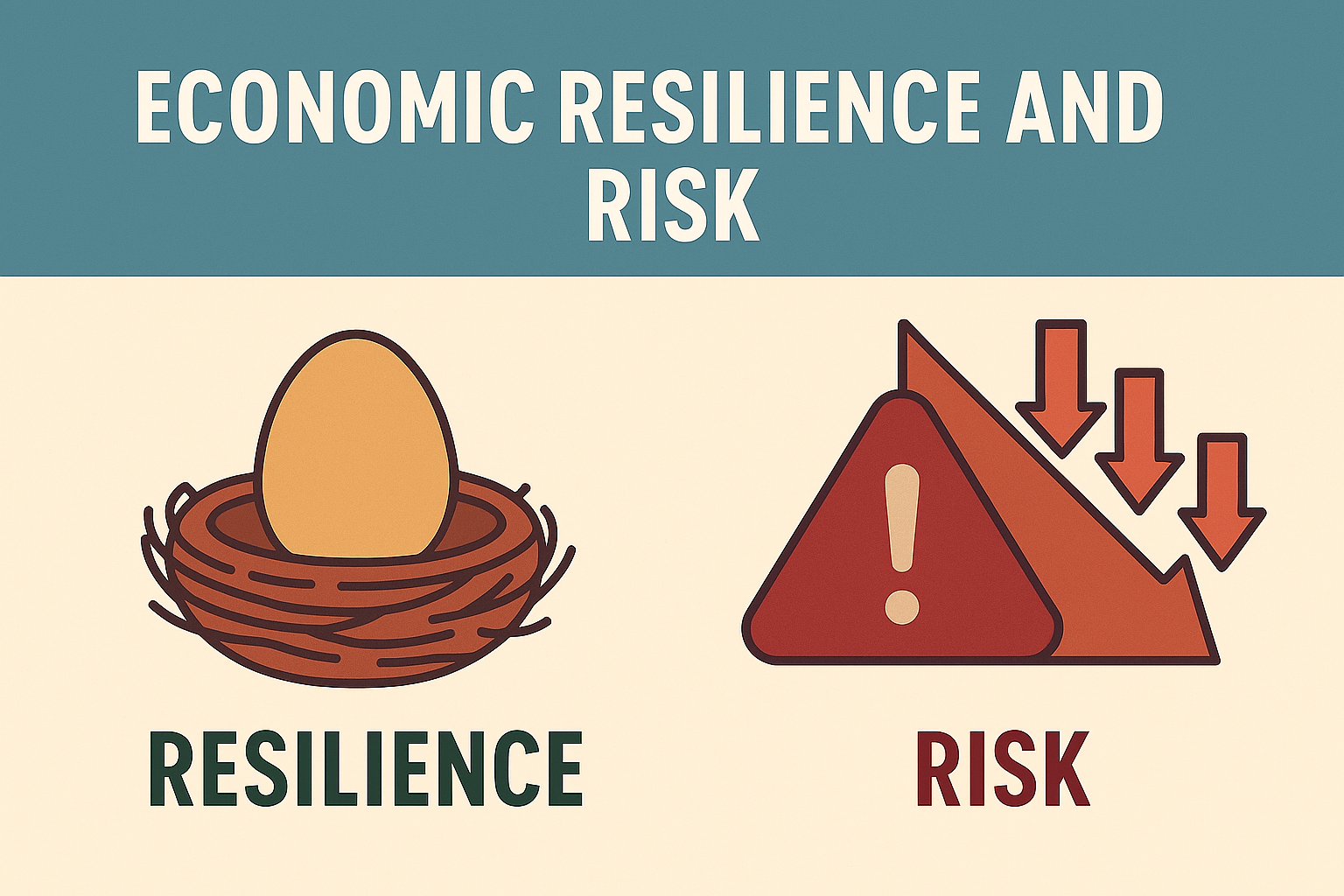
Economic resilience and risk exist like twin forces shaping the world we live in—two sides of the same coin that determine how individuals, communities, businesses, and entire nations respond to change, challenges, opportunities, and crises. To understand them is to understand why some economies bounce back from disasters, recessions, or global shocks stronger than before, while others collapse, stall, or take years—sometimes decades—to rebuild. Economic resilience is the system’s capacity to absorb shocks and recover, while economic risk represents the potential threats and vulnerabilities that disrupt economic stability. The more resilient a system is, the lower the long-term damage caused by risk. Yet without risk, resilience would never develop or even matter. That is the fascinating balance—where survival, adaptation, and growth meet challenge, instability, and uncertainty.
Economic resilience is more than a technical economic concept; it’s a story of people, their adaptability, their interdependence, their creativity, and endurance. Be it the households coping with losses of jobs, small businesses adapting to supply chain disruptions, or countries facing inflation, global energy crises, or pandemics, resilience shows something about the strength of systems to cope. And risk, well, that is always there-unknown, unpredictable, sometimes silent, and sometimes loud. Economic resilience is the shield, while risk is the test.
Understanding the Core Idea.
Essentially, economic resilience is the system’s ability to maintain function, stability, and continuity in case something goes wrong-a recession, a pandemic, a war, a natural disaster, a financial crash, or even a technological disruption. It is like a building constructed with shock absorbers-not to prevent earthquakes but to withstand them.
On the other hand, economic risk refers to anything that threatens financial stability, economic output, livelihoods, or long-term development. Every individual, business, or government carries risk-from personal debt to unstable income, from fluctuating global oil prices to climate disasters affecting agriculture.
Resilience characterizes economic systems when they sustain shocks and rebound relatively fast. Those that break down under pressure expose vulnerabilities and a lack of preparedness.
Personal and Household Economic Resilience
Let’s start small, with individuals and families.
Imagine a family where only one member earns an income; if this person were to become unemployed, then the whole household would be in jeopardy. There is no fallback, no other source of backup income. This lack of diversification makes the household economically fragile.
Now, consider a household with diversified income streams-maybe one full-time earner, one running a side business, perhaps some rental income, savings, and a small investment portfolio. Disruption in one of those streams, and the household still functions. That is resilience.
Here, resilience comes from:
Savings and emergency funds
Diversified income streams
Skills that allow one to adapt to new job markets
Low levels of indebtedness or manageable debt
Risk emanates from:
Job dependency
Increased cost of living without increased income
High-interest loans
No financial planning or savings
The theme of economic resilience at the household level is deeply emotional, not just financial. It hits at the heart of a family’s sense of safety, dignity, and long-term dreams. Without resilience, risk can turn into crisis very fast.
Business Economic Resilience and Risk
Businesses work in constantly changing environments: market trends shift; customer preferences vary; supply chains get disrupted; technology evolves; and competition grows.
A business that has high resilience:
Has multiple suppliers, not just one
Maintains financial reserves
Uses technology to stay efficient
Trains workers in adaptive skills
Innovates rather than waiting for change to force innovation
An organization with a high risk exposure:
Depends on a single market or supplier
Carries high debt in unstable markets
Cannot adjust to changed technologies.
Responds slowly to changes in demand.
Has no strategic planning
COVID-19 showed this emphatically. Businesses that had online capacity, flexible supply chains, and digital adaptability survived even to prosper. Those that did not have resilience collapsed.
National and Global Economic Resilience
At a national level, economic resilience involves:
Strong and diversified industries
Stable governance and institutions
Healthy labor markets
Balanced trade relations
Effective social safety nets
Investments in innovation
Countries that rely too much on one sector or export are very vulnerable. For example:
When oil prices fall, oil-dependent economies suffer.
When travel is disrupted, tourism-dependent economies collapse.
Climate-sensitive economies face hardships when weather conditions deteriorate.
Other ingredients of national economic resilience include:
Currency stability
Ability to borrow affordably
Strength of the banking system
Levels of public trust
The risk at this level appears from:
Global recessions
Trade wars
Natural disasters
Sanctions
Technological disruption
Political instability
But resilience results from planning, diversity, preparedness, education, and long-term strategy.
Shocks That Test Resilience
Examples of such events that show how resilient systems really are include :
Pandemics
Wars
Financial crises
Natural disasters
Commodity price shocks
Technological disruptions
Climate change
A resilient economy would absorb these shocks, adapt, restructure, and regain momentum.
A non-resilient economy collapses into:
Unemployment crises
Inflation soars
Currency failures
Social unrest
Declining investment
The difference lies in preparedness and flexibility.
The Human Side: Adaptation, Learning, and Innovation
Resilience is ultimately a human quality before it is an economic one: people adapt, learn, innovate, and rebuild.
Economic resilience grows when:
People have access to education and development of skills
Societies foster creativity and do not punish change.
Cultures value problem-solving and critical thinking.
Policies support entrepreneurship and experimentation
Risk is less threatening when people are empowered to respond, not just to suffer.
Resilience Is Not Just Survival—It Is Growth
Resilience is not static; it evolves.
Resilient Economy:
Does not just survive shocks, but becomes stronger because of them.
Learns from crises, rather than repeating them.
Uses crises as opportunities to redesign systems more intelligently.
For example:
Banking regulations improved after financial crises.
After pandemics, health systems grew.
After climate disasters, sustainable infrastructure was strengthened.
Risk propels innovation. Resilience ensures survival with progress.
How to Build Stronger Economic Resilience
Across all levels-household, business, and national-resilience is built through:
Resilience Strategy Why It Matters
Diversification Reduces dependence and spreads risks
Savings & Reserves: Smoothen shocks
Education & Skill Development Enable adaptation and new opportunities
Innovation & Technology Adoption: Keeps systems competitive and efficient
Trade and Institutional Flexibility: Allows adjustment in global markets
Social Safety Networks: Protect the vulnerable and maintain stability.
Resilience relies on preparation before crisis, not reaction during crisis. It is often too late to build safety nets once the crisis hits. Conclusion: The Balance Between Risk and Resilience Risk can never be completely avoided. No economy can eradicate uncertainty. Things will always change. But resilience transmutes uncertainty into manageable challenge, not disaster. Resilience is strength—not the absence of hardship but the ability to adapt, evolve, and continue forward with purpose, learning, and creativity. It is economic resilience and risk that shape the story of human development: the more resilient a society, the more confidently it moves into the future, prepared not just to withstand whatever change may come but to shape it. Risk is the storm; resilience is the structure that stands through it, sometimes weathered, but still standing, still growing, still striving.
Leave a Reply