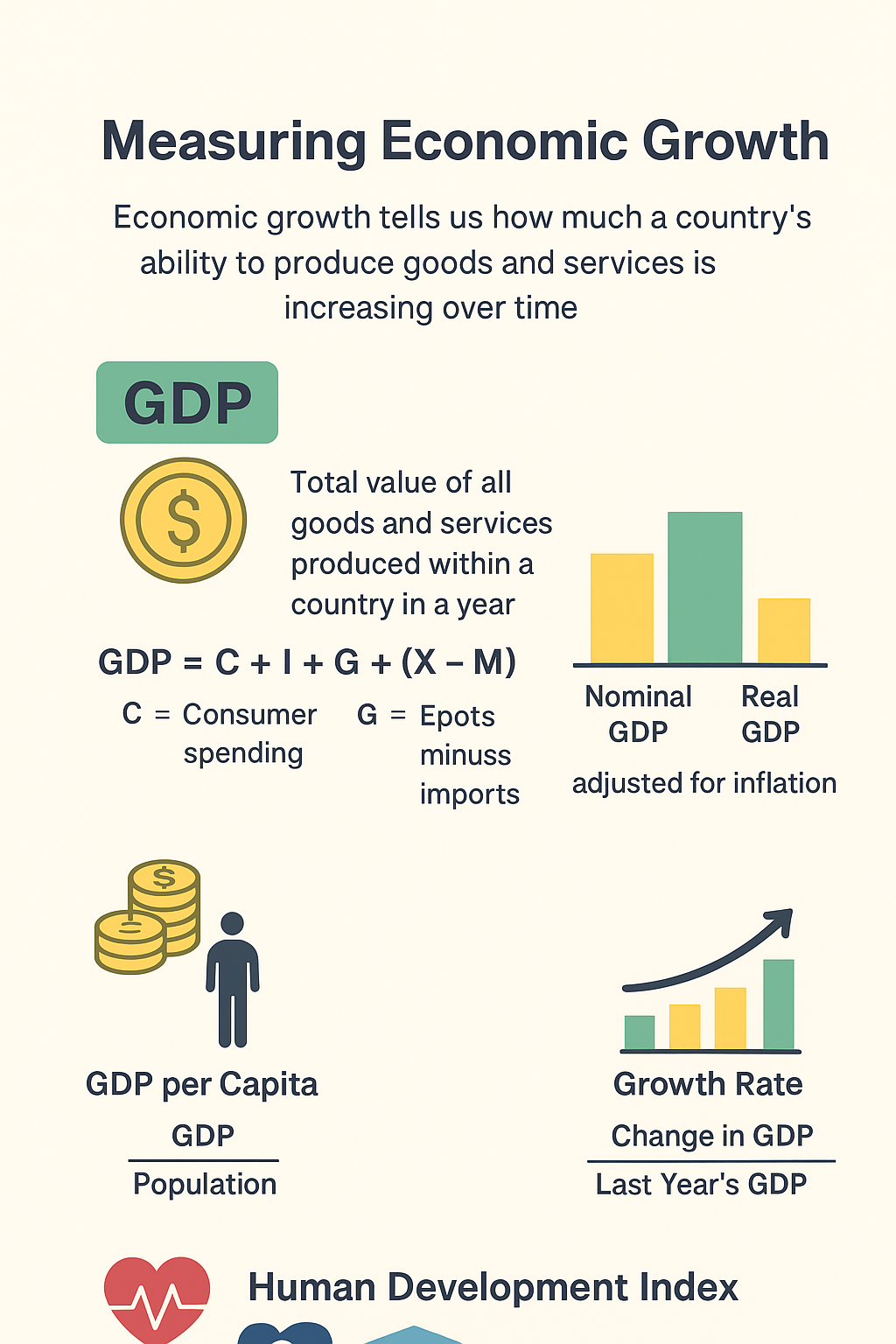
Economic growth is one of those big phrases we hear in news headlines, political speeches, and policy debates. Leaders talk about “boosting growth,” analysts talk about “slowing growth,” and everyday people are often told that growth is the key to jobs, opportunities, better wages, and national progress. But what does economic growth really mean?
And more importantly, how do we measure it?
To understand economic growth, we need to begin with the basics. At its core, economic growth describes how much a country’s production of goods and services increases over time. When a country produces more—more cars, more machines, more medical services, more education, more technology—it is said to be growing.
But that is just the surface. Real growth is not only about producing more; it is about improving living standards, creating opportunities, reducing poverty, and ensuring that people can lead secure, fulfilling lives. Because growth without benefits to people is simply expansion without purpose.
So, how do economists, governments, and institutions actually measure economic growth?
Let’s break this down carefully, clearly, and meaningfully.
Gross Domestic Product (GDP): The Most Common Measure
When discussing growth, the term GDP (Gross Domestic Product) almost always appears first. GDP represents the total monetary value of all goods and services produced within a country in a specific period, usually one year.
Why GDP is Widely Used
It provides a standardized, numerical way to compare economies.
It is consistently calculated across countries, making global comparisons possible.
It is a relatively broad reflection of economic activity.
Three Ways GDP is Calculated
Economists can calculate GDP in three different yet theoretically equivalent ways:
Method Description Example
Production Method Adds up all goods and services produced in the economy. If a bakery produces bread worth $100, we count that $100.
Income Method Adds up all income earned by workers and firms. Wages + business profits + rent + interest.
Expenditure Method (most common) Adds up all spending in the economy. GDP = C + I + G + (X − M)
Where:
C = Consumer spending
I = Investment spending
G = Government spending
X − M = Exports minus imports
This formula gives a full picture of who is spending, how much, and on what.
Nominal GDP vs. Real GDP
Simply measuring GDP in money terms is misleading because prices change over time. A rise in GDP might not mean more production—it could just mean inflation.
Nominal GDP
Measured using current prices.
Can be misleading if inflation is high.
Real GDP
Adjusted for inflation.
Shows the true growth in output.
Example:
If a country’s nominal GDP rises by 10%, but inflation is 8%, real growth is only about 2%.
Real GDP answers the key question:
Did we actually produce more, or did things just become more expensive?
- GDP Per Capita: Measuring Growth Per Person
A country may have a large GDP simply because it has a large population. To understand living standards, we use GDP per capita:
GDP per Capita
GDP
Population
GDP per Capita=
Population
GDP
Why This Matters
It shows average economic output per person.
It is a rough indicator of average income and quality of life.
Example:
India has a large total GDP because it has many people.
But GDP per capita is much lower than countries with smaller populations but higher income levels, like Norway or Switzerland.
GDP per capita helps identify whether the people in a growing economy are actually better off.
- Growth Rate: How Fast an Economy is Growing
We don’t just observe GDP—we observe how it changes over time.
Growth Rate
GDP in Current Year
−
GDP in Previous Year
Previous Year GDP
×
100
Growth Rate=
Previous Year GDP
GDP in Current Year−GDP in Previous Year
×100
This tells us whether an economy is:
Expanding (positive growth)
Stagnating (zero growth)
Contracting (negative growth or recession)
Countries aim for stable growth—too high causes inflation, too low causes unemployment.
Beyond GDP: Why GDP Isn’t Enough
GDP is powerful, but it has serious limitations, because:
GDP Does Not Measure:
Important Reality Why GDP Fails to Capture It
Income inequality A few wealthy people can raise GDP while many remain poor.
Unpaid work (caregiving, homemaking) These activities have huge value but no price tag.
Environmental damage Cutting forests boosts GDP temporarily but harms long-term sustainability.
Happiness and well-being GDP does not measure life satisfaction, health, or community stability.
You could have:
High GDP growth with widespread poverty.
Rising incomes but falling environmental health.
High production but low happiness.
Growth alone does not guarantee human progress.
Human Development Index (HDI): A More Human Measure
To fill this gap, the United Nations developed the HDI (Human Development Index), which measures:
HDI Component What It Represents
Income Standard of living
Education Knowledge and skill development
Life Expectancy Health and longevity
HDI focuses on human well-being, not just wealth.
A country may have moderate GDP per capita but strong health and education systems — and thus a high HDI score.
Other Modern Measures of Growth
a. GNI (Gross National Income)
Accounts for income earned abroad by citizens and companies.
b. Green GDP
Subtracts environmental damage from GDP to show sustainable growth.
c. Happiness and Well-Being Indices
Measures quality of life, mental health, stability, social trust, and personal fulfillment.
Countries like Bhutan use Gross National Happiness (GNH) to guide policy instead of GDP.
Why Measuring Growth Matters
Accurate measurement allows governments to:
Plan budgets
Set taxes
Build infrastructure
Improve healthcare and education
Encourage jobs and innovation
Investors use growth data to:
Decide where to invest
Predict profits
Plan market strategy
Individuals are affected too:
Growth affects job availability
Wages and cost of living
Housing, schooling, and daily life
Economic growth touches every part of society.
The Human Side of Growth
Economic growth is not just numbers; it is people’s lives.
Growth means:
A mother can afford medicine for her child.
A student can attend university.
A family can move into a safe home.
A worker can earn a fair wage with dignity.
When growth is inclusive, it expands opportunity, choice, and hope.
But when growth benefits only a few, it leads to frustration, instability, and inequality.
So the true measure of growth is not just how much we produce —
but how widely the benefits are shared.
Conclusion: Measuring Growth with Purpose:
To truly understand economic progress, we must look at several dimensions:
Measure Captures Limitation
GDP Total production Ignores distribution and well-being
Real GDP True output growth Still economic-centered
GDP per Capita Average living standard Can hide inequality
HDI Human well-being Doesn’t show environmental cost
Green GDP Sustainability Harder to calculate
The best measure combines all of these.
Economic growth should mean:
People live longer, healthier lives
Workers earn fair incomes
Opportunities are accessible to all
Future generations inherit a sustainable world
Growth is not just about becoming richer —
it is about becoming better
Leave a Reply