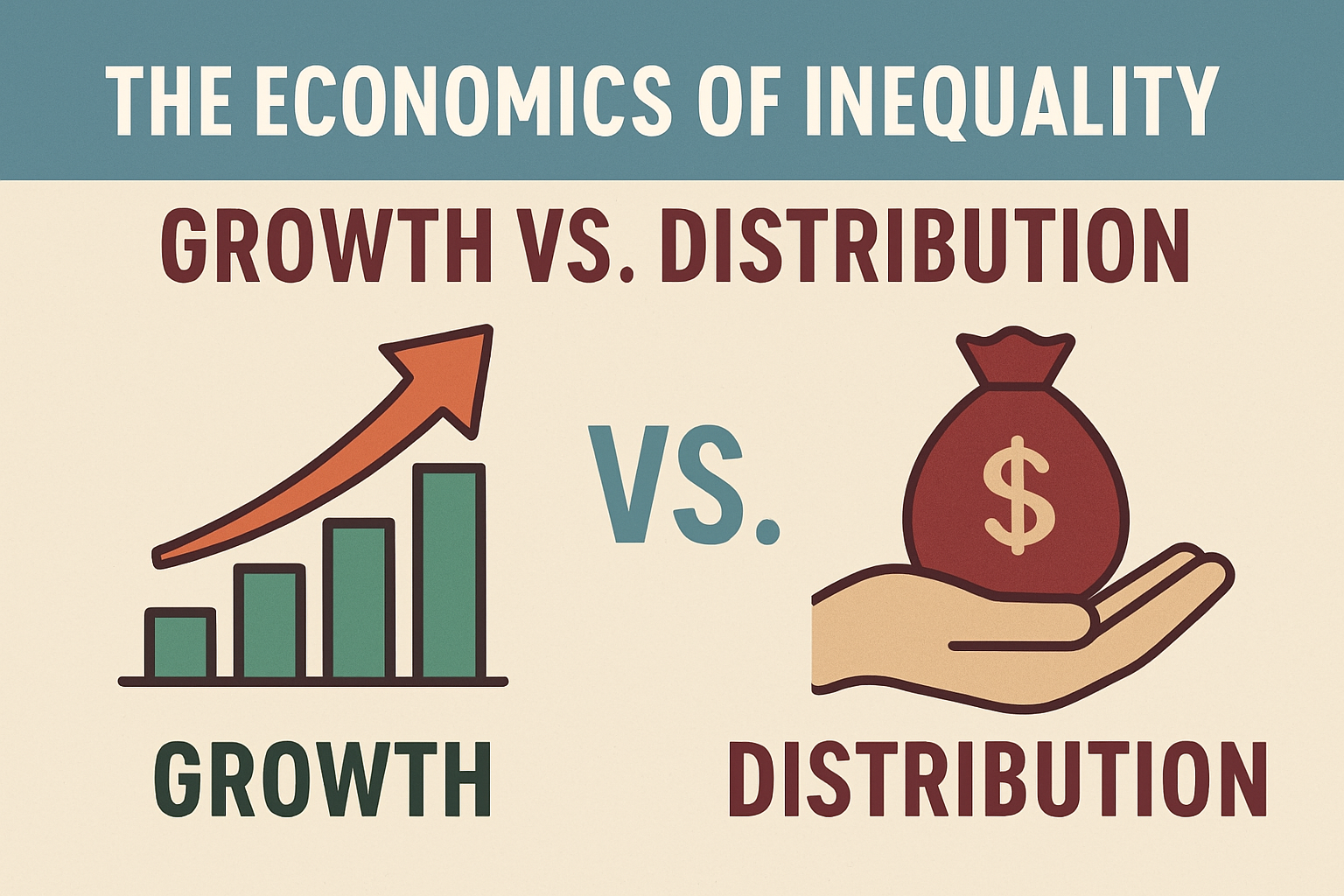
The Economics of Inequality: Growth vs. Distribution — A Human-Centered Understanding.
Inequality is one of those subjects that involves us all, whether we realize it or not. It defines the neighborhoods in which we grow up, the schools we attend, the types of jobs we have access to, and the futures we envision for ourselves. It defines how safe we feel, how hopeful we stay, how we treat one another, and how society works at its most basic level. But discussions of inequality always seem to get couched in technical economic language-GDP growth, income distribution, fiscal policy, productivity, capital accumulation-until the human meaning gets lost.
That’s the problem at the heart of debates about growth vs. distribution.
Many leaders, economists, and governments say that the best method to improve society is first to grow the economy-increase production, expand industries, boost business profits-and then assume that the benefits will eventually “trickle down” to everyone else.
Others believe the exact opposite: that a strong foundation for a healthy and stable society with very fair wages, universal access to education and healthcare, social safety nets, progressive taxation-in other words, focusing on distribution FIRST-is what gives long-term growth its best support.
This debate is not solely technical.
It is moral.
It is philosophical.
It is about what kind of world we believe we owe to each other.
To understand inequality, we have to look, not just into numbers, but also at stories, structures, emotions, and lived realities.
Growth: The Story We’ve Been Told.
For decades, governments have been guided by one central idea:
When the economy grows, everyone benefits.
It is based on classical economic theory and can be referred to as:
“Trickle-down economics.”
The logic is simple:
If firms make greater profits, they invest more.
More investment means more jobs.
More jobs translate into more income for workers.
More income means greater well-being for society.
This story is comforting.
It promises progress without sacrifice.
It promises improvement without conflict.
It promises that we do not need to ask hard questions about fairness, power, or structure — we only need patience.
But here is the central problem:
The benefits of growth do not trickle down equitably.
Over the last 40 years:
The top 1% has seen their wealth skyrocket.
The wages of the middle class have stagnated.
Low-income workers have struggled just to stay above survival.
Productivity has increased, but wages haven’t kept pace with it.
Housing, healthcare, and education costs have increased more quickly than earnings.
This means something fundamental:
Wealth is being created; it is not being shared.
Growth is taking place, but it is accumulating at the top.
For millions of families worldwide, the promise “wait long enough and things will get better” is simply not true. In many ways, life for them has become more stressful, more uncertain, more fragile.
Growth is not enough when the benefits of that growth accrue to a small group alone.
Distribution: The Structure of How Wealth Is Shared.
Distribution is about how value generated within a society is allocated to the members who live within it.
This includes:
Wages and salary levels
Tax systems
Public services
Ownership of land and resources
Who has access to good education, who does not
Who has the security of finances and who lives from paycheck to paycheck
In an unequal society:
Rich people can afford better healthcare, housing, and education.
This gives their children advantages.
These advantages add up to more wealth and influence.
Meanwhile, the ones on the bottom find it more difficult to break away from the cycle.
Inequality solidifies into hierarchy over time.
It is no longer only about the money; it becomes about opportunity.
Not everyone is born with the same opportunities.
They are born into different starting lines.
This is not simply an economic issue; it is a social structure.
The Human Experience of Inequalit
To understand inequality properly, one needs to perceive it in the body and mind.
For those at the top:
Inequality manifests as comfort, safety, freedom, and choice.
They can afford time — time to rest, time to think, time to make decisions.
Because even failure is survivable, their children aren’t weighted down by the fear of it.
For those in the middle:
Inequality manifests itself as stress.
They are not poor enough to receive support, yet not wealthy enough to feel secure.
They are always one crisis away from instability.
They learn to live with a constant background stress.
For those at the bottom:
Inequality shows up as exhaustion.
Every day is a negotiation of essentials: food or medicine, rent or school costs.
They are not choosing between good and better; they are choosing between survival and loss.
This emotional dimension matters.
Fear changes behavior.
Stress reduces creativity.
Hopelessness decreases one’s involvement in society.
A highly unequal society is not just economically imbalanced:
it is emotionally fractured.
Why Growth Alone Cannot Solve Inequality
Economic growth focuses on increasing the size of the pie.
But inequality is about how the pie is divided.
If the pie grows, but only a few people receive bigger slices, then growth does not improve life for all, and in fact, can make inequality worse.
Economic systems naturally tend to concentrate wealth over time because:
Those who have wealth can reinvest to generate more of it.
Those without wealth, however, cannot accumulate enough to become independent.
Capital grows more rapidly than wages.
This means that inequality is not an accident; it is a structural outcome.
And without fair distribution, growth becomes a machine serving ever fewer people.
This is not only unfair, it is economically inefficient.
When millions of people do not have enough to live fully, they cannot:
Spend money
Invest in education
Start businesses
Contribute new innovations
Inequality curtails potential.
It wastes talent.
It slows progress.
It creates social instability.
A society where many struggle and few flourish is not a strong society.
It is a fragile one.
Why Distribution Strengthens Growth
When wealth is distributed equitably:
People are healthier.
Children are better educated.
Workers are more motivated
Communities are safer
Economies become more resilient.
Distribution does not mean “taking from the rich and giving to the poor” in a simplistic sense.
It means investing in shared systems that benefit everyone, like:
Good public schools throughout all areas
Affordable health care so that illness does not destroy families
Living wages consistent with the real cost of living
Support for small businesses, instead of only large corporations
Social programs that help people rise rather than sink
Distribution lays a strong foundation.
And a strong foundation is a must for sustainable long-term economic growth.
The most successful economies in history — such as the post-war US, the Nordic countries, and the modern East Asian development models — all grew because they invested heavily in equitable distribution early on.
Wherever society is strong, growth thrives.
When distribution is fair, society is strong.
The Emotional Core: What Kind of World Do We Want to Live In?
Inequality is much more than numbers, charts, or theories.
It is about:
Whether people feel they belong.
Whether they think their efforts matter.
Whether they can dream without fear.
Whether they can rest easy without guilt.
Whether they can imagine a future not defined by struggle.
The debate between growth vs. distribution is ultimately a debate between two visions of humanity:
Vision 1:
Everyone should try to survive for themselves, with luck dictating what happens.
Vision 2:
We are responsible for creating conditions in which everyone can thrive.
One view sees society as competition.
The other looks upon society as co-operation.
We assume success is an individual affair.
The other perceives that success is collective.
The truth is:
Nobody succeeds alone.
Everyone is constituted by invisible networks of support: teachers, roads, electricity, language, culture, public infrastructure, emotional care.
Economy is not something apart from humanity.
Economy is humanity, the way we organize our shared life.
So, the real question is:
Do we believe that everybody deserves dignity, safety, and opportunity?
If yes — then we have to decide on systems that allocate resources fairly, not arbitrarily.
Way Forward: Balancing Growth and Distribution Together
It does not have to be an either/or debate.
The healthiest economies combine:
Growth: Incentivizing innovation, business development, creativity, and entrepreneurship.
Distribution: Making sure those benefits of growth lift living standards for all.
This requires:
Fair labor policies
Progressive taxation
Universal access to education and healthcare
Effective regulation of monopolies and finance
Investment in public goods
Empowering communities, not just corporations
When economies grow and distribute fairly:
Crime decreases
Social cohesion strengthens.
Increased political stability Trust rises Improvement in mental health Culture becomes more dynamic. People are more willing to help one another. A just society is not only morally right but also: it is economically smart. Final Thought: Inequality Is Not Destiny — It Is a Choice Inequality is not a law of nature. It is not an inevitable result. It is something that societies create – and can change. We are not trapped. We are responsible. The world we live in today is a product of decisions taken earlier by governments, businesses, and communities. It all depends on what choices we make to determine what kind of world we will live in next. If we choose to believe that: every life has equal value. a fair chance for every person, and the purpose of an economy is to support human well-being, then we will build systems that reflect those beliefs. Because a society is ultimately not judged by the amount of wealth it produces — but how it treats the people who produce it.
Leave a Reply